IPO ROADSHOW BRIEF
SpaceX IPO Roadshow: Project Apex (June 2026)
 Rizvi Updated June 5
Space Exploration Technologies Corp. is going public on Nasdaq (and Nasdaq Texas) under ticker SPCX, offering 555.6M primary shares at $135 for roughly $75B in gross proceeds (about $86B with the greenshoe) and a ~$1.77 trillion implied valuation, which would make it about the 7th-largest US company, above Tesla. Pricing is expected June 11, 2026. The pitch: the only company vertically integrated across Space, Connectivity, and AI, today addressing a $5.7T near-term market that AI expands toward $28.5T. 2025 revenue was $18.7B (up 33%) with $6.6B Adjusted EBITDA, though still GAAP loss-making as capex hit $20.7B. All figures as of or for the twelve months ended March 31, 2026 unless noted.
OFFERING
The deal
TERMS
- Issuer
- Space Exploration Technologies Corp. (SpaceX)
- Offering size
- 555.6M shares (100% primary)
- Over-allotment
- 15% greenshoe (100% primary)
- Offering price
- $135 per share
- Implied gross proceeds
- ~$75.0B base; ~$86.3B with full greenshoe
- Exchange / ticker
- Nasdaq; Nasdaq Texas / SPCX
- Expected pricing date
- June 11, 2026
- Use of proceeds
- Expand AI compute infrastructure, enhance launch infrastructure and vehicles, scale satellite constellations, and general corporate purposes
- Lock-up: Elon Musk
- 366-day lock-up
- Lock-up: others
- Staggered release for select investors, officers, and directors from after Q4'26 earnings through Q2'27 earnings; staggered early release for all other shares from after Q2'26 earnings through 180 days post-IPO
- Bookrunners
- Goldman Sachs, Morgan Stanley, BofA Securities, Citigroup, and J.P. Morgan, plus Barclays, Deutsche Bank, RBC Capital Markets, UBS, and Wells Fargo
- Co-managers
- Allen & Company, Cantor, Needham, Raymond James, Societe Generale, Stifel, William Blair, BTG Pactual, ING, Macquarie Capital, Mirae Asset, Mizuho, and Santander
OVERVIEW
What the company is
Mission and positioning
The mission: build the systems to make life multiplanetary, understand the universe, and extend the light of consciousness to the stars. Lowering the cost of space access funds adjacent missions: bridging the digital divide by aiming to connect 3B+ unconnected people, and meeting AI's exponentially rising resource demands. SpaceX positions itself as an "N of 1": the only company building integrated hardware and software across three businesses, Space (since 2002), Connectivity (since 2020), and AI (since 2023). The repeatable model: leverage launch to enable scale, identify trillion-dollar markets, design with first-principles engineering, apply "The Algorithm" (make requirements less dumb, delete, optimize, accelerate, automate), vertically integrate to the end customer, drive cost down and throughput up, then reinvest the cash flow.
SCALE AS OF Q1 2026
THREE PILLARS
| Pillar | Since | Headline stats |
|---|---|---|
| Space | 2002 | ~650 launches; 95%+ of 2025 missions on reused boosters; 80%+ of global mass to orbit since 2023; 78 crew safely flown |
| Connectivity | 2020 | 9,600+ Starlink satellites (~75% of active maneuverable sats); 164 countries; ~10.3M subscribers |
| AI | 2023 | 4 major Grok model releases; ~350M daily posts on X; ~550M MAU; ~1.0 GW nameplate compute |
TAM
Market opportunity
ADDRESSABLE MARKET
| Bucket | Near-term | With AI expansion |
|---|---|---|
| Space | $370B | $370B |
| Connectivity | $1.6T | $1.6T |
| AI | $3.8T | $26.5T |
| Total | $5.7T | $28.5T |
TAM breakdown
Near-term $5.7T splits into Space-enabled solutions $370B; Starlink Broadband $870B and Starlink Mobile $740B (Connectivity $1.6T); and AI Infrastructure $2.4T, Consumer Subscriptions $760B, and Digital Advertising $600B (AI $3.8T). The AI-expanded view layers in Enterprise Applications of $22.7T, lifting AI to $26.5T and the total to $28.5T.
MOMENTUM
2026 so far
KEY EVENTS THIS YEAR
- Feb-26
Acquired xAI
Done - Feb-26
Starlink surpassed 10M active customers
Done - Mar-26
Terafab announced
DoneStrategic collaboration with Tesla to build the world's largest chip manufacturing facility. Intel joined in April 2026.
- Apr-26
X Ads Manager launch
DonePhased roll-out of the advertising platform began.
- Apr-26
Grok 4.3 released
DoneFastest, most intelligent Grok model to date.
- Apr-26
Cursor partnership
DonePartnered with Cursor to advance Grok.
- May-26
Anthropic compute agreement
DoneEntered into cloud services agreements to provide access to compute.
- May-26
EchoStar spectrum licenses
DoneReceived FCC approval of the EchoStar license transfer.
- May-26
Starship V3 flew
DoneCompleted Starship's 12th test flight, the first of Starship V3.
- May-26
American Airlines agreement
Done
ROADMAP
Milestones ahead
WHAT'S NEXT
| Program | Timing | Target |
|---|---|---|
| Starship V3 | H2 2026 | Commence payload delivery to orbit; 100 metric tons per launch over time |
| Broadband V3 satellite | H2 2026 | Begin deployment on Starship; 1,024 Gbps per satellite |
| Mobile V2 satellite | 2027 | Begin deployment on Starship; 5G speed, voice, and data |
| Terrestrial compute | Next phase | 400MW+ in Colossus II; 220K+ additional GB300s |
| AI compute satellite | 2028 | Begin deployment on Starship; ~100KW compute per metric ton |
SEGMENT 1
Space
REUSABLE FLEET
| Vehicle | Payload to LEO | Flights | Success |
|---|---|---|---|
| Falcon 9 | 23 t | ~620 | 99% |
| Falcon Heavy | 64 t | 11 | 100% |
| Starship V3 | 100 t | 12 | Testing phase |
| Future Starship | 200 t | n/a | Reusable target |
The launch advantage
SpaceX flew 165 Falcon-family launches in 2025 and holds 80%+ of global mass to orbit since 2023 (share rose from 45% in 2021 to 65% in 2022 to 80%+ across 2023 to 2025, per BryceTech). Reusability has driven launch cost per kg to LEO from a $18,500 historical average (1970 to 2000) down to about $2,700 on Falcon 9 (85% reduction) and $1,400 on Falcon Heavy (92%), with Starship targeting a 99%+ reduction. The remaining Starship technical milestone is catch and re-flight of the ship; the goal is airline-like operations where methane and liquid oxygen propellant is the only marginal cost per launch.
LAUNCH COST PER KG TO LEO            linear bars, max = $18,500

Historical avg, 1970 to 2000   $18,500   ████████████████████████████████████████  baseline
Falcon 9                        $2,700   ██████                                    down 85%
Falcon Heavy                    $1,400   ███                                       down 92%
Starship  (full-reuse target)    ~$100   ▏                                         down 99%+

Reusability is the flywheel: once boosters and ship are fully reused,
CH4 + LOX propellant becomes the only marginal cost per launch.
SEGMENT 2
Connectivity
20X+ BANDWIDTH PER LAUNCH WITH V3
| Metric | V2 (today) | V3 (H2 2026) |
|---|---|---|
| Bandwidth per satellite | 96 Gbps | 1,024 Gbps |
| Satellites per launch | 27 (on Falcon 9) | 60 (on Starship) |
| Bandwidth per launch | 2,600 Gbps | 61,000 Gbps |
Starlink at scale
Starlink runs 9,600+ satellites (about 75% of all active maneuverable satellites; 3,000+ deployed in 2025 vs roughly 3,200 for everyone else combined). Subscribers grew 2.3M (2023), 4.4M (2024), 8.9M (2025), to 10.3M in Q1 2026, with YoY growth of 97%, 100%, then 105%. Coverage spans 164 countries and 3.3B+ people at 99.9% average uptime, 225 Mbps median download (vs ~120 Mbps for average terrestrial ISPs) and ~25ms latency. Enterprise and government use spans fixed site, land mobility, maritime, aviation, and Starshield, with customers including KDDI, John Deere, Brightline, Royal Caribbean, Maersk, Emirates, United, and government bodies like FEMA. Starlink Mobile is the largest satellite-to-mobile constellation: ~30 mobile network operators, ~1.9B people covered, ~650 V1 mobile satellites, and 65MHz of spectrum, delivering 5G to unmodified phones and IoT. V2 mobile deployment begins in 2027; the EchoStar spectrum acquisition (65MHz plus global MSS licenses) is expected to close November 2027.
SEGMENT 3
AI
The integrated AI stack
SpaceX frames itself as the only company that can vertically integrate across AI compute infrastructure, a frontier model (Grok), and real-time data (X). Colossus I and II form what the deck calls the world's largest coherent supercomputer: first gigawatt-scale training cluster, first gigawatt-scale Megapack battery installation, first to deploy GB200s and GB300s at significant scale, at ~1GW nameplate compute draw. The orbital AI compute thesis: US terrestrial supply is constrained (2025 supply 49 GW vs 62 GW demand), so space-based compute is pitched as readily available (solar-powered, no current regulatory hurdles), cheaper to operate (radiative cooling, Starlink data routing) and to deploy (falling cost per kg to orbit), and faster to refresh with new chip generations. AI compute satellites are targeted to begin deploying on Starship in 2028. Selling compute: a cloud compute services agreement with Anthropic across Colossus and Colossus II, at a $1.25B monthly fee through May 2029 (subject to conditions). Selling intelligence to enterprise: Grok Enterprise and Grok API, plus the Cursor partnership with an option to acquire Cursor at an implied equity value of $60B. Selling intelligence to consumers: ~117M MAU using Grok's AI features, with 2B+ videos and ~10B images produced monthly by Imagine. X itself has ~550M MAU and ~350M daily posts, with a strategy to become an "Everything App" spanning real-time info, communications, media, payments, and banking, alongside X Premium conversion and the new X Ads Manager.
NUMBERS
Financials
CONSOLIDATED ($B)
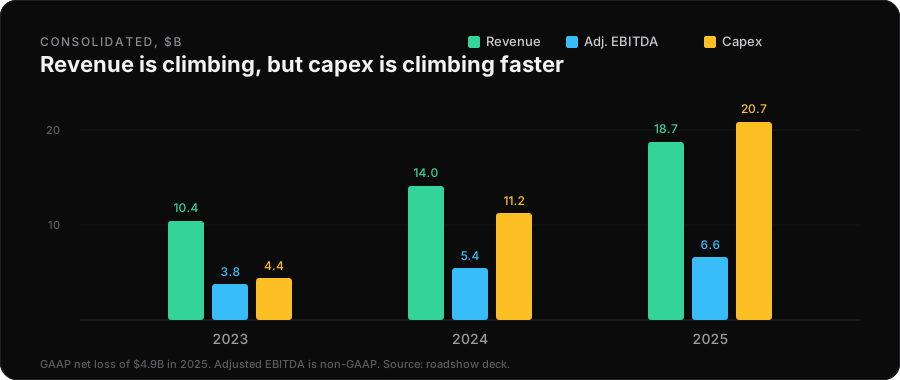
| $B | 2023 | 2024 | 2025 | Q1'26 |
|---|---|---|---|---|
| Revenue | 10.4 | 14.0 | 18.7 | n/a |
| Adj. EBITDA | 3.8 | 5.4 | 6.6 | 1.1 |
| Net income (loss) | (4.6) | 0.8 | (4.9) | (4.3) |
| Capex | 4.4 | 11.2 | 20.7 | n/a |
BY SEGMENT (2025)
| Segment | Revenue | YoY | Adj. EBITDA |
|---|---|---|---|
| Space | $4.1B | +8% | $0.7B |
| Connectivity | $11.4B | +50% | $7.2B |
| AI | $3.2B | +22% | ($1.2B) |
MARGIN TARGETS
| Metric | 2025 | Future target |
|---|---|---|
| Revenue growth | 33% | Significantly higher |
| Gross margin | 49% | ~70% |
| GAAP net income margin | (26%) | ~45% |
Reading the financials
Connectivity is the profit engine: $11.4B revenue in 2025 (up 50%) and $7.2B segment Adjusted EBITDA. Space revenue is smaller and reflects external customer launches only (no inter-segment revenue for deploying SpaceX's own satellites), with segment Adjusted EBITDA dipping to $0.7B in 2025 as Starship R&D accelerated ($3.0B). The AI segment is still investing through losses ($1.2B negative segment Adjusted EBITDA in 2025). Group capex climbed to $20.7B in 2025 across all three segments, and SpaceX raised about $9B for Space and Connectivity. Adjusted EBITDA and Segment Adjusted EBITDA are non-GAAP; targets are goals, not projections.
VALUATION
Valuation and comps
VALUATION SNAPSHOT
- Implied valuation
- ~$1.77 trillion at $135 per share
- Shares offered
- 555.6M primary plus an 83.33M greenshoe; ~$75B raise (~$86B with greenshoe)
- US market-cap rank
- ~#7, above Tesla (~$1.6T)
- 2025 sales multiple
- ~95x ($1.77T / $18.7B revenue)
- 2025 Adj. EBITDA multiple
- ~270x ($1.77T / $6.6B)
- Private marks
- ~$800B (late 2025), then ~$1.25T after the xAI merger (Feb 2026), now ~$1.77T at IPO
- Musk voting control
- ~85% post-IPO
SELECTED COMPARABLES
| Company | Valuation | Sales basis | ~Multiple |
|---|---|---|---|
| SpaceX (IPO) | ~$1.77T | $18.7B FY2025 | ~95x sales (~270x EBITDA) |
| OpenAI | ~$852B | ~$25B run-rate | ~34x |
| Anthropic | ~$965B | ~$47B run-rate | ~21x |
| Rocket Lab (RKLB) | ~$40B to $70B | ~$0.9B FY2026E | ~30x fwd (2027E) |
| AST SpaceMobile (ASTS) | ~$33B | ~$0.15B to $0.2B FY2026E | ~42x fwd (2027E) |
| Tesla (size ref) | ~$1.6T | n/a | n/a |
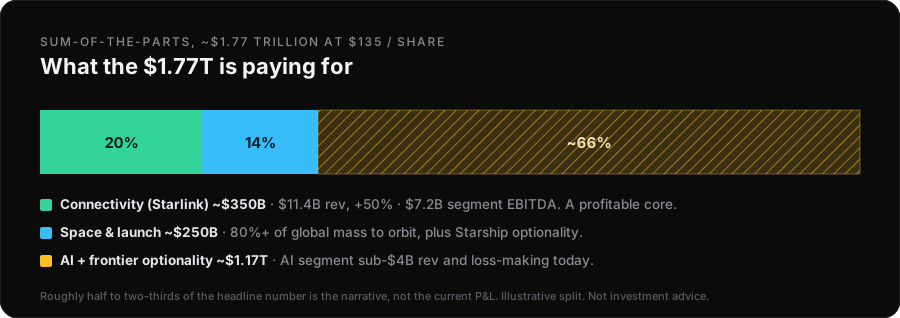
At ~$1.77T on $18.7B of 2025 revenue, SpaceX is asking for roughly 95x trailing sales and about 270x Adjusted EBITDA, with no GAAP profit. That is far above any public comparable on a trailing basis. Even the richly-valued listed space pure-plays trade near 30x to 42x forward (2027E) sales: Rocket Lab around 30x and AST SpaceMobile around 42x, at market caps in the tens of billions. The closest large-cap analogs on multiple are the private AI labs, OpenAI (~$852B on ~$25B run-rate, ~34x) and Anthropic (~$965B on ~$47B run-rate, ~21x), but those are compounding run-rate revenue several times a year, which SpaceX's AI segment is not. A sum-of-the-parts lens is the honest way to look at it. Connectivity (Starlink) did $11.4B revenue in 2025 (up 50%) at $7.2B segment Adjusted EBITDA: a genuinely profitable, fast-growing core that, even at a generous infrastructure multiple, might support a few hundred billion of value. Space and launch ($4.1B external revenue, dominant share, Starship optionality) could justify another couple hundred billion at premium launch multiples. That leaves the majority of the ~$1.77T resting on AI and frontier optionality (orbital compute, lunar, Mars), where the AI segment today is sub-$4B in revenue and loss-making. In short, roughly half to two-thirds of the headline number is paying for the narrative, not the current P&L. That gap is exactly what the bull and bear cases argue over. None of this is investment advice.
THE DEBATE
Bull case vs bear case
Bull case
- The only company vertically integrated across space, connectivity, and AI, with moats (launch cadence, constellation, vertical integration) that are nearly impossible to replicate.
- Starlink is a real, profitable engine: $11.4B revenue (+50%), $7.2B segment EBITDA, 10.3M+ subscribers, 164 countries. V3 satellites deliver 20x+ bandwidth per launch.
- Launch dominance: 80%+ of global mass to orbit, lowest cost per kg, a reusability flywheel. Starship scales payload from 100t to 200t and opens new markets.
- Stacked optionality: orbital AI compute (claimed $26.5T TAM), lunar economy, Mars, and point-to-point. A portfolio of moonshots on top of a profitable core.
- AI monetization is starting: the Anthropic compute deal ($1.25B per month to May 2029), the Cursor option ($60B), and Grok plus X real-time data as a differentiated stack.
- Scarcity and index demand: the only public way to own the category leader, with a Musk halo and large passive inflows at a $1.77T cap.
- The $75B+ raise funds the capex-heavy buildout and de-risks execution.
Bear case
- Extreme valuation: ~95x 2025 sales and ~270x Adjusted EBITDA, with a GAAP net loss (-26% margin, -$4.9B in 2025) and $20.7B capex. Priced for near-flawless execution.
- Most of the value is optionality: orbital AI compute is still in the design stage (satellites not before 2028), lunar and Mars are long-dated, and the $26.5T AI TAM is aspirational.
- Governance and key-man risk: Musk keeps ~85% voting control, with related-party entanglements (Tesla and Terafab, xAI, X) and little say for minority holders.
- Technical and regulatory gating: Starship is still in testing (catch-and-reflight of the ship is unproven); cadence, spectrum, and approvals (EchoStar closes Nov 2027) are bottlenecks.
- Competition everywhere: Rocket Lab (Neutron), AST SpaceMobile, Amazon Kuiper, and Blue Origin in space; OpenAI (~$852B) and Anthropic (~$965B) plus hyperscalers far ahead in AI.
- AI is sub-scale: ~$3.2B revenue and loss-making versus frontier labs at $25B to $47B run-rates. The AI thesis is mostly promise today.
- Lock-up and macro risk: staggered share releases begin after Q2'26 earnings, and a megacap IPO into a frothy AI tape carries de-rating and rate-duration risk.
PEOPLE
Leadership and culture
CULTURE METRICS
- Top 3 executives
- Elon Musk, Gwynne Shotwell, Bret Johnsen
- Engineer applicants accepted (2025)
- <2%
- Avg tenure, top 3 executives
- 21 years
- Avg tenure, senior management
- 12 years
LONG-TERM
Future markets
WHERE GROWTH GOES NEXT
- Lunar economy: human Moon return with NASA Artemis by late 2020s, sustainable lunar base, and lunar factories to manufacture AI compute satellites powered by solar and a lunar mass driver
- Mars: passenger and cargo transport, plus energy production and manufacturing on Mars
- Point-to-point terrestrial travel via Starship
- In-orbit manufacturing and asteroid mining
- Design and manufacture own chips (Terafab) and launch digital human augmentation
Caution
Status and basis of figures
This is a confidential roadshow deck tied to an S-1 that has not yet become effective; securities cannot be sold before effectiveness. The deck contains forward-looking statements and non-GAAP measures. Comparable-company figures are from public reporting as of early June 2026 and mix trailing, forward, and run-rate revenue, so multiples are directional, not like-for-like. Unless otherwise noted, SpaceX statistics are as of or for the twelve months ended March 31, 2026. Not investment advice.
Sources
- [1]SpaceX targets $135 IPO price at $1.77T valuation (CNBC)https://www.cnbc.com/2026/06/03/spacex-ipo-stock-price-roadshow-musk.html“At $135 per share SpaceX would be valued at $1.77T, the 7th-biggest US company, above Tesla; 555.6M shares for a ~$75B raise plus an 83.33M-share greenshoe.”
- [2]Anthropic nears $965B valuation, $47B run-rate (CNBC)https://www.cnbc.com/2026/05/28/anthropic-open-ai-startup-value.html“Anthropic reported a ~$47B revenue run rate while raising near a $965B valuation; OpenAI was valued at $852B in late March.”
- [3]OpenAI $852B valuation, ~$25B run-rate (TechCrunch)https://techcrunch.com/2026/04/14/anthropics-rise-is-giving-some-openai-investors-second-thoughts/“OpenAI's $852B valuation drew skepticism from some investors; Anthropic run-rate climbed from $9B to $30B by end of March.”
- [4]RKLB ~31x and ASTS ~42x 2027E sales (Motley Fool)https://www.fool.com/investing/2026/03/27/better-buy-ast-spacemobile-or-rocket-lab/“Rocket Lab and AST SpaceMobile traded around 31x and 42x their 2027 revenue estimates, at market caps of roughly $37B and $33B.”